Reliable Slip Ring Solutions for Modern Excavators
2026-01-19 14:32:53Excavators are among the most essential machines in today’s construction and infrastructure projects. One of their defining characteristics is the ability of the upper structure to rotate continuously relative to the undercarriage, enabling flexible and efficient operation across a wide range of tasks. Behind this seemingly simple movement lies a critical technical challenge: maintaining stable transmission of power and control signals during uninterrupted 360-degree rotation. This is where slip rings become a core enabling component.
Why Slip Rings Matter in Excavator Performance
In modern excavators, especially those operating under heavy loads and demanding duty cycles, system reliability is a top priority. Any interruption in signal or power transmission can directly impact machine accuracy, safety, and productivity. Slip rings function as the electrical bridge between stationary and rotating parts, allowing power, control signals, and feedback data to pass smoothly while the machine slews continuously.
As construction equipment increasingly integrates electronic control systems, sensors, and intelligent monitoring functions, the role of the slip ring has evolved from a basic rotating connector into a mission-critical subsystem.
JINPAT Engineering Approach to Excavator Slip Rings
As a professional manufacturer specializing in industrial slip rings, JINPAT has accumulated long-term experience in developing solutions for construction machinery applications. JINPAT excavator slip rings are engineered to operate reliably in environments characterized by strong vibration, mechanical shock, dust, moisture, and long operating hours.
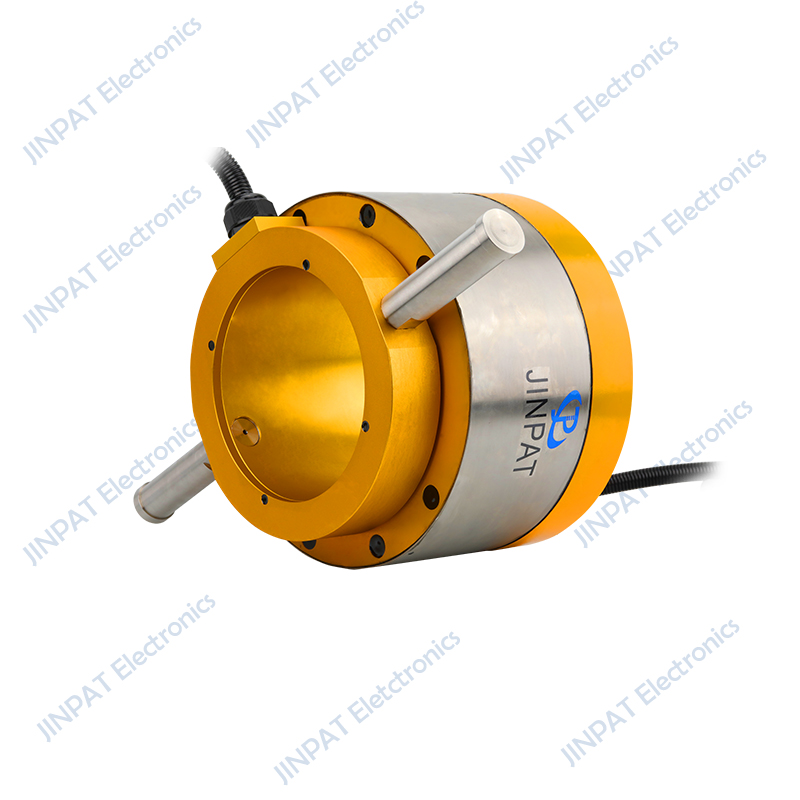
From a structural perspective, JINPAT offers both through-bore slip rings (such as LPTS120-0230-16S and LPT200-0430-0210-06S) for applications requiring central shaft integration, and compact non-through-bore designs (including LPTS000-0602, LPTS000-0330-1105, and LPTS000-0350-1605) for machines with limited installation space. All designs are customized based on actual equipment architecture.
Designed for Harsh Construction Environments
Internally, JINPAT excavator slip rings utilize automotive-grade wiring and optimized contact structures to ensure stable transmission of throttle signals, CAN bus communication, angle feedback, and encoder signals. Proprietary anti-vibration and anti-shock design concepts enable the slip rings to maintain electrical stability even under continuous heavy-duty operation.
With strict material selection, standardized manufacturing processes, and comprehensive quality control, JINPAT slip rings help excavators maintain consistent slewing accuracy within ±2°, supporting precise operation and long-term system reliability—key considerations for contractors and OEMs in the U.S. market.